

The Jakarta Administrative Court’s Ruling Is Baffling and Ignores the Facts Presented at the Trial Regarding the 2025–2060 RUKN Lawsuit: Indonesian Citizens Must Continue to Fight!

Jakarta, May 5, 2026 – The Jakarta Administrative Court’s ruling dismissing the lawsuit against the 2025–2060 National Electricity Master Plan (RUKN) on the grounds that it is not the subject matter an administrative decision indicates that the panel of judges disregarded the facts that emerged during the RUKN trial through documentary evidence, fact witnesses, and experts presented by the parties.
In the previous hearing, the experts—namely Dr. Richo Andi Wibowo, S.H., LL.M. (expert in administrative law), Prof. Ir. Tumiran, M.Eng., Ph.D. (expert in energy and electricity), and Prof. Dr. M. R. Andri Gunawan Wibisana, S.H., LL.M. (environmental law expert), had clearly explained that Constitutional Court Decision No. 39/PUU-XXI/2023 explicitly states that “the oversight function must begin as soon as the planning of an activity is formulated,” and thus this can serve as a strong basis for the judges’ consideration that the RUKN is a legally binding plan.

The national electricity policy contained in the 2025–2060 National Electricity Master Plan (RUKN) is not a new policy, as it is a more detailed elaboration of the policies set forth in the National Energy Policy (KEN). The RUKN serves to implement these policies, including the underlying laws and regulations. The content of the RUKN as the Subject of Dispute is regulated in Law No. 30 of 2009 on Electricity and Minister of Energy and Mineral Resources Regulation No. 8 of 2021, which specifies the concrete and individual nature of the Subject of Dispute in Article 5 of Minister of Energy and Mineral Resources Regulation No. 8 of 2021.
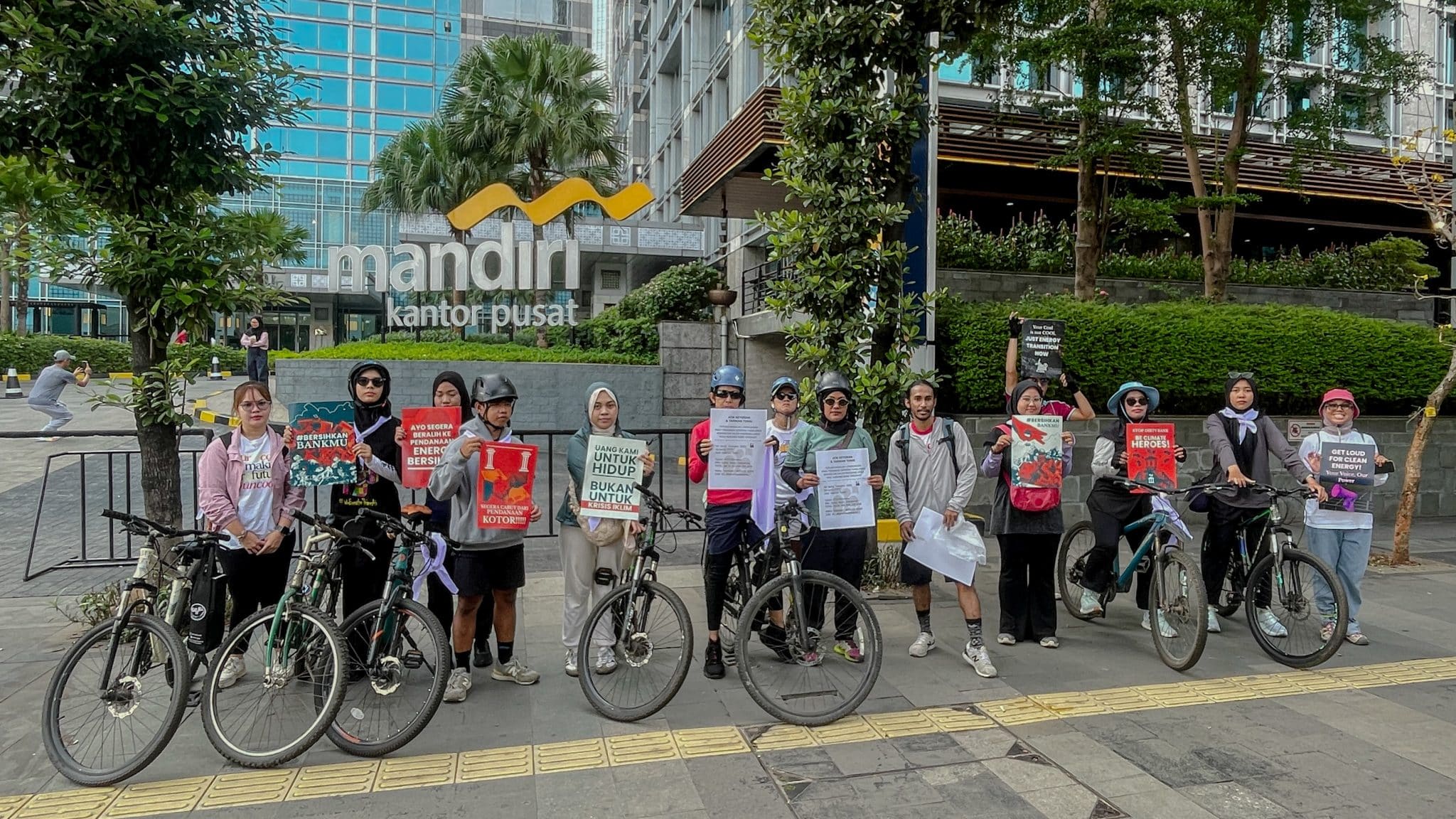
“We respect the Jakarta Administrative Court’s ruling. However, what was examined in court was not intent, but rather the procedures and substance of the RUKN, and that is where the problem is clearly evident. The facts revealed through hundreds of pieces of evidence —letters, several statements from factual witnesses, and expert testimony from individuals with diverse backgrounds—indicate the existence of fundamental issues within the RUKN under review,” said Renie Aryandani from the Bersihkan Indonesia Advocacy Team.
The phenomenon of the dismissal or the ruling Niet Ontvankelijke Verklaard (NO) regarding a number of civil society lawsuits in several recent cases indicates a certain trend in judicial review practices at the Administrative Court (PTUN), which warrants collective attention in the context of strengthening access to justice.
“Therefore, we believe there are still differences in the assessment of the facts and the application of the law in this decision. We will follow up on this through available legal avenues, namely by filing an appeal, to ensure that every administrative decision—in this case, issued by Bahlil Lahadalia as Minister of Energy and Mineral Resources—truly complies with the principles of legality, accountability, and the general principles of good governance,” added Renie Aryandani.
The panel of judges at the Jakarta Administrative Court should understand that the RUKN is not merely a plan on paper, as this document is used to shape the national electricity system—including the formulation of provincial general electricity plans—as well as state business and investment decisions. The judges of the Administrative Court should retain jurisdiction because there are real and direct legal consequences arising from the plan since the RUKN includes, among other things: the background (key points of the National Energy Policy [KEN] related to electricity and the legal basis), the National Electricity Policy, the status of national electricity supply, projections for national electricity demand and supply, and the development plan for the national electricity supply system.
“WALHI objects to the Jakarta Administrative Court’s ruling because the panel of judges failed to view the RUKN as a government policy that extends the operation of coal-fired power plants (PLTU), rather than accelerating their early retirement. This policy has the potential to exacerbate environmental and local economic inequalities, as evidenced by WALHI’s lawsuit against the coal-fired power plants operated by PT Stardust Estate Investment, PT Gunbuster Nickel Industry, and PT Nadesico Nickel Industry—a case upheld by the Poso District Court—which clearly demonstrated that the plants’ operations have a detrimental impact on river pollution and the local community’s economy. The RUKN cannot be viewed as a normative, forward-looking, or planning policy for the electricity sector, because its impacts are already being felt by the environment and the community,” said Boy Jerry Even Sembiring, National Executive Director of WALHI.
This ruling shows that the Jakarta Administrative Court did not take into account that the RUKN was procedurally flawed because it did not include a comprehensive, participatory environmental impact analysis and lacked a Strategic Environmental Assessment (SEA), which is a prerequisite for its preparation.
In the process of drafting the 2025–2060 National Spatial Plan (RUKN), the Ministry of Energy and Mineral Resources did not engage in meaningful participation with the public or provincial governments. According to evidence revealed during the hearing, at least four provinces in Indonesia—namely North Maluku, Bali, Southeast Sulawesi, and South Sulawesi—stated that they were never involved or included in the process of drafting the 2025–2060 RUKN [1].

Currently, the Bersihkan Indonesia Advocacy Team is also challenging the 2025–2034 Electricity Supply Business Plan (RUPTL). The ruling on the 2025–2060 National Energy Master Plan (RUKN) exacerbates the issue of inconsistency in government policies, as it is not aligned with the National Energy Policy (KEN). Yet the 2025–2034 RUPTL refers to the 2025–2060 RUKN.
In 2024, the Financial Supervisory Agency (BPK) noted that a lack of alignment between policies issued by the Ministry of Energy and Mineral Resources and PLN could result in interest-bearing debt (debt accruing interest on loans) exceeding safe limits, as well as increase the burden of electricity subsidies and compensation from 2025 to 2040.
“The Jakarta Administrative Court’s puzzling ruling not only missed an important opportunity to save Indonesia—which is highly vulnerable to the catastrophic impacts of the climate crisis [2]—but also ignored the fiscal crisis and economic hardships currently facing the Indonesian people. This deviant ruling by the Jakarta Administrative Court cannot obscure the fact that the current National Energy Policy (RUKN) opts for the most wasteful and unrealistic energy sources, while simultaneously increasing energy vulnerability and offering minimal environmental benefits, and was issued without the involvement of local governments. With this ruling, the Indonesian people’s sovereignty over energy is slipping further and further out of reach,” said Ahmad Ashov, Program Director at Trend Asia.
Editorial Note:
[1] The court evidence regarding the statements made by these four regional heads was obtained through a request submitted to the Provincial Information and Documentation Management Officer (PPID).
[2] Law No. 51 of 2009 on the Second Amendment to Law No. 5 of 1986 on Administrative Courts stipulates that the preliminary review of a complaint to assess whether it meets formal requirements (dismissal process) should be conducted at an early stage and decided by the Chief Judge.
Media Contact
Renie Aryandani, Bersihkan Indonesia Advocacy Team, +62822-9228-2338
Boy Jerry Even Sembiring, WALHI National Executive Director, +62857-7993-3255
Ahmad Ashov, Trend Asia Program Director, +62811-1757-246
Share Article: